Journal of Codicology and Manuscript Research
(In persian: Pizhūhish/hā-yi nuskhah/shināsī va taṣḥīḥ-i mutūn)

Journal of Codicology and Manuscript Research (In persian: Pizhūhish/hā-yi nuskhah/shināsī va taṣḥīḥ-i mutūn)


Number of Volumes 5
Number of Issues 9
Number of Articles 104
Number of Contributors 171
Article View 76,778
PDF Download 55,429
View Per Article 738.25
PDF Download Per Article 532.97
 
Number of Submissions 238
Accepted Submissions 108
Acceptance Rate 45
Time to Accept (Days) 61
Number of Indexing Databases 3
SCImago Journal & Country Rank


The Journal of Codicology and Manuscript Research (JCMR)(In Persian: Pizhūhish/hā-yi nuskhah/shināsī va taṣḥīḥ-i mutūn) is an open-access, double-blind, peer-reviewed Journal publication by The Scientific Association of Manuscript Research and Codicology of IRAN.

This semiannual journal publishes original scientific articles, invluding research papers, review, short papers, case studies, methodologies, concepts, applications, and viewpoints about Codicology and Manuscript Research. For more detail, refer to the journal's scope. 

The journal adheres to the Committee on Publication Ethics (COPE) and complies with the highest ethical standards in line with established publication laws. All submitted manuscripts are checked for similarity using Samim noor, Hamyab, and ithenticate software to ensure their authenticity, followed by rigorous peer review by expert reviewers. The authors and editors of the journal are careful about and avoid any conflict of interest in writing and publishing articles. (Declaration form) Authors should include the following statement at the end of their articles: All authors declare that they have no conflicts of interest.

 

Ask Us...


Journal Features

  • Publication Frequency: semiannual
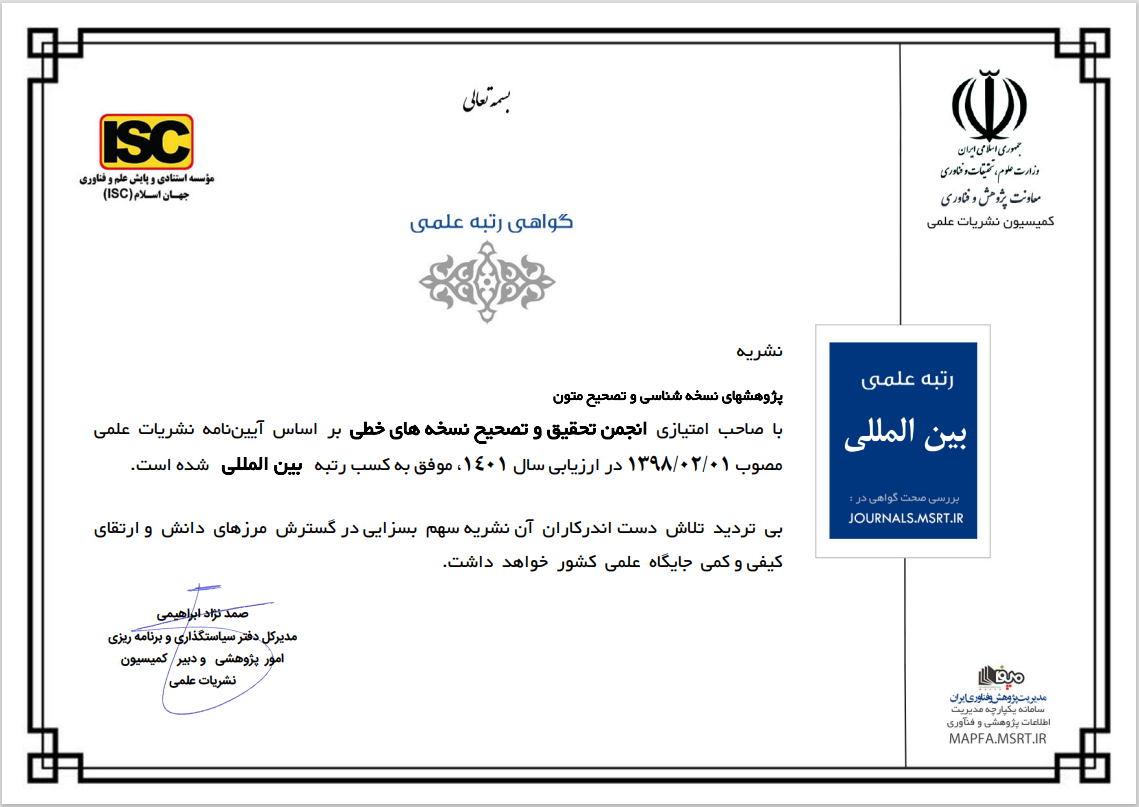
  • Ministry of Science of IRAN Rank: International
  • Peer review Process: Double blind
  • Language: Persian (with English Abstract)
  • publication format: Print & Online
  • Access Type: Open access (full text available)
  • Article Processing Charges: Yes (see Journal APCs)
  • Correspondence:  For inquiries, contact the journal at Info@makhtootat.ir
  • For immediate assistance: Utilize the chat feature available at the bottom of this page.
  • When submitting an article, authors are required to provide complete and accurate details of their department, faculty, university, province, country, and ORCID ID in the author affiliation section.
  • It is not possible to change and update the affiliation after the publication of the article.
  • An ORCID research identifier is mandatory for all authors. If you do not have one, please obtain it here. (get ID)
  • The Journal follows APA Style for References, in all matters listed in the guidelines below. as detailed in the guidelines. For more information, refer to the instructions for referencing scientific publications. You can use tools like openl.io and similar ones for translating resources.
  • Authors must translate the entire list of references of their article into English and upload it to the journal's system.
  • With the aim of attracting a general audience in the scientific space and based on keywords, write a phrase of up to 15 words titled "Highlights" in Persian and English after the article's title on the article's abstract page.
  • They should also write the reference address of their article in the authors' information file in both Persian and English.
  • Author Last name, First initial. Middle initial. (Year Published). Title of article. Title of Periodical, Volume(Issue), page range. DOI

Permitted uses of artificial intelligence in article editing:

  • Grammar and readability control
  • Review of research literature
  • Image production or editing of artwork or visual abstract of the article for printing Analysis and processing of statistical data
    (with due observance of ethical principles of transparency and declaration of the use of artificial intelligence in each section)


  • Prohibition of the use of artificial intelligence:
    Citation of content created by artificial intelligence that lacks external reality, as well as analysis and writing of any part of the text and conclusions of a scientific article, are not permitted.


Current Issue: Volume 5, Issue 2 - Serial Number 10, September 2026, Pages 1-331 

Keywords Cloud

  • Manuscript
  • correction
  • manuscripts
  • codicology
  • stylistics
  • criticism
  • Najm al-Dīn Rāzī
  • Necessity of Correction
  • Distortion
  • manuscript research
  • mystical exegesis
  • proofreading
  • Hafez
  • critique
  • Sufism
  • text correction
  • textology
  • Bahr al-Ḥaqāʾiq
  • Textual Criticism
  • Shams al-Dīn Sāwajī
  • Manuscriptology
  • Critical Edition
  • Persian proseTayebehuddin Arzanjani
  • writers
  • Jami&‌rsquo
  • critical edition of manuscript
  • The textual analysis
  • Mohammad Sadegh Nami Isfahani
  • History
  • manuscription
  • scientific society
  • Astan Quds Razavi library
  • manuscripts of Qurans
  • riddle
  • animal motifs
  • Jalaloddin Davani
  • Jang Nāmeh ye Muhammad ibn al-Hanafiyya
  • Bahram and Golandam story
  • Khalil-e Zargar Rashti
  • literary and jurisprudential structure of Qurans
  • \"Arbaeen-Nevisi\"
  • Reader-centered Approach
  • Diwan
  • Arithmetic
  • Al Basāer Va AlNazāer
  • Mahbūb al-Qulūb
  • Basiri Khorasani
  • Muhammad Ibn Hossein Ma\'ini
  • Mir Sayyed Sharif Horufi
  • s manuscript 2051
  • \" Ottoman\"
  • Bakhrazi
  • Safavid era painting
  • Abu Mekhnaf
  • Badiul Zaman Forozanfar
  • Hafez Shirazi
  • Junonul-Majanint
  • Sayeh
  • faghih kermani
  • translated manuscripts
  • Jafari Al &‌‌ndash
  • Revenue and Expenditure Instruction of Hamedan and Qaraguzlu
  • Andarz
  • Jame al-Maqamat
  • Shahnameh
  • Armaghan Asefi
  • Kashan
  • Persian poetry
  • Khaghani
  • right to divorce
  • Marriage certificate
  • Attached Verses
  • Persian unknown words
  • Genology
  • \" iran\"
  • Sanai\'s Qit&‌‌‌‌‌lsquo
  • مخطوطة
  • Banaei Heravi
  • poetry collections&‌‌rdquo
  • Sheikh Bahāʾi
  • ؛ amā؛ Matlōb al-Ahbāb؛ Holale Motarraz dar Fann-e Mo´
  • Moinuddin Ahmad
  • Husseini
  • Inter-textual Relations
  • anthology
  • Cheshtiyya
  • Abdul Razzaq Samarqandi
  • Aljavāhir Li- Maserrat-ul-Khavātir
  • Erfan
  • Dabir alam
  • Holy Qur\'an
  • Qawamuddin Sanjani
  • cultural infrastructure
  • Plagiarism
  • Zolal al-Safa
  • Fazl bin Mohib Nishaburi
  • Museyyeb-Nāmeh
  • Zandiyeh
  • exegetical coucils
  • &‌‌ldquo
  • Ghawsiyyah
  • critic
  • Qajar women
  • Codicology, Niʿmat Khān &‌‌lsquo
  • purity of heart
  • Arbainiyat
  • \"Leyli and Majnun poem\"
  • manuscript. &‌‌emsp
  • Qasim Anwar
  • Basiri
  • ancient texts&‌‌rdquo
  • Khajeh Nasir al-Din Tusi
  • quatrains&‌‌rdquo
  • Valuation Criteria
  • مظفرمخطوطة
  • handwrite manuscript
  • Tohfatol-A\'azem \'Alam Ara
  • interpretation
  • Lail and Nahar
  • Keywords: Tazkirat al-Abrar
  • practical mysticism
  • Talebani&‌‌rdquo
  • Sayf al-Molook and Badi\' al-Jamal
  • \"Az\"
  • arc and cornea
  • Sahayef al-Latayef
  • authenticity of manuscripts
  • love
  • financial documents
  • margin writing
  • المتنبی
  • Al -Sharara
  • travel book. Bostan al-Sayah
  • Muhammad bin Lad
  • Qeyṣarī \'s Commentary
  • eightt century
  • Abu al- Hasan Bayhaqi
  • Literature Traditions
  • 10th century poetry
  • ODE
  • Bahoo
  • Ahmad Kasani
  • : Abu al-Baqa
  • s history\"
  • Islamic Civilization
  • Scientific and cultural studies
  • Backgammon
  • Alaa al-Molk
  • Najid Al-Din Reza Tabrizi Esfahani
  • Shayeq Lorestsni
  • Ilm al-Remayah
  • mysticism
  • Organizing
  • Baha al-Din Mattu
  • translated Quran
  • National Library
  • Punjabi
  • Shiraz
  • Attribution of poems
  • Mohammad Taghi Mousavi
  • National Identity
  • Codex
  • Iran
  • Timurid era
  • Zain al-Abdin Isfahani
  • \"recruitment Laws\"
  • \"bringing down the camel from the roof\"
  • Abd al-Shakur
  • Behrooz and Bahram
  • Poem editing
  • Irfan
  • \"criticism\"
  • Guletan-e-Eram
  • introduction and criticism
  • Painting
  • vaghaei
  • Safavid
  • function
  • recruitment\"
  • critical editing
  • Zillallah
  • text
  • text reconstruction
  • Tarsal and Essay
  • subcontinent
  • Dastūr-i Muʿammā
  • Al-Hidayah fi &‌lsquo
  • Divan-eKabir&‌‌rdquo
  • origin
  • mystics
  • adat
  • Waqf notes
  • \"Mowlavi\'s followers\"
  • style of the Timuri period
  • \"correction\"
  • \"secondary sources\"
  • Mulla Sadra
  • Keywords: Manuscript
  • Arithmetic and Mathematics
  • Correct Recording